
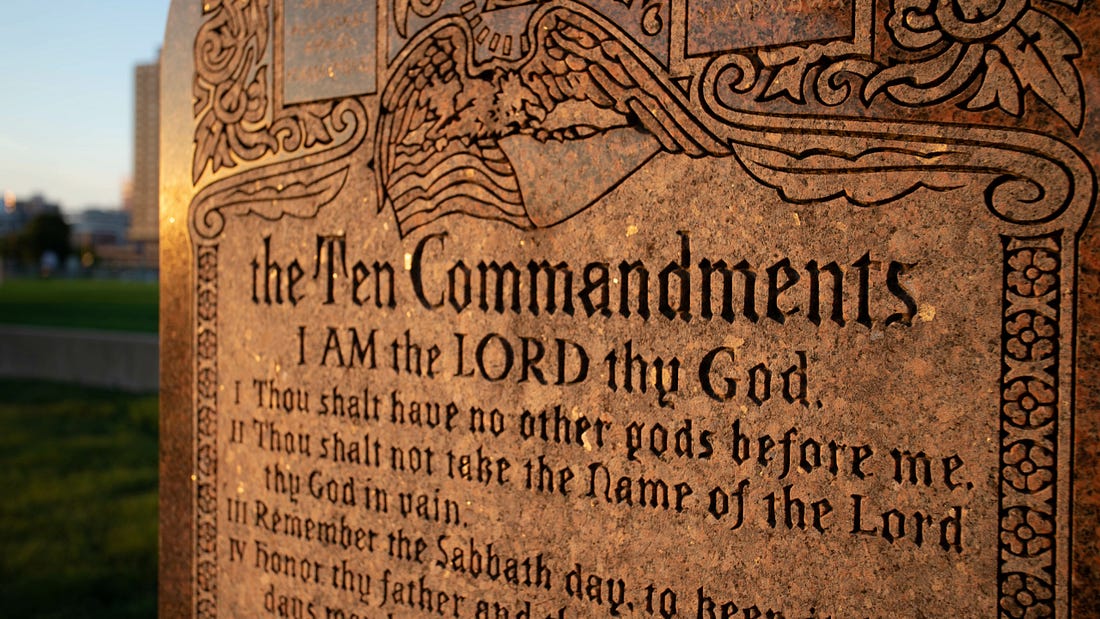
Cartazes com os Dez Mandamentos devem ser afixados nas escolas antes que famílias da Louisiana possam entrar com ações judiciais, determina tribunal federal.
O Quinto Circuito admitiu que a lei pode ser inconstitucional, mas está obrigando os alunos a suportarem manifestações religiosas antes de contestá-las.
Em uma decisão que parece tão inútil quanto frustrante, um tribunal de apelações decidiu que os Dez Mandamentos podem ser afixados nas escolas públicas da Louisiana e que contestações judiciais contra isso não podem ser apresentadas até que isso aconteça.
 |
Uma ação judicial anterior para bloquear a lei dos Dez Mandamentos da Louisiana havia sido bem-sucedida tanto no tribunal distrital quanto no tribunal de apelações — os juízes chegaram a afirmar que a lei era “claramente inconstitucional” —, mas o Tribunal de Apelações do Quinto Circuito, em sua totalidade, solicitou a reconsideração do caso e, por 12 votos a 6, decidiu reverter a decisão anterior de seus colegas. (Você pode ler o histórico completo deste caso aqui .)
Quando um grupo desses juízes decidiu a favor dos demandantes no ano passado, eles disseram que não precisavam esperar que os Dez Mandamentos fossem afixados, pois a lei já deixava claro o que esses cartazes deveriam conter. Por que submeter crianças à doutrinação religiosa quando se pode prevenir isso? De fato, o juiz do Tribunal Distrital afirmou que deixar a lei entrar em vigor (e, consequentemente, os demandantes se depararem com as exibições) seria um "ônus considerável" para essas famílias. Não havia necessidade de esperar, escreveu ele, quando a lei era tão flagrantemente ilegal.
Aparentemente, não foi assim que o Quinto Circuito, em sua totalidade, interpretou a questão.
Em sua decisão de 46 páginas, eles escreveram que as famílias envolvidas precisavam esperar para ver os cartazes antes de poderem entrar com uma ação judicial, “porque ainda não sabemos — e não podemos saber — como o texto será usado”. (Em termos jurídicos, disseram que o caso ainda não estava “maduro”.)
Pedir-nos que declaremos — aqui e agora, e em abstrato — que toda e qualquer exibição possível da HB 71 violaria a Cláusula de Estabelecimento exigiria precisamente o que o Texas proíbe : a substituição da especulação pela adjudicação. Isso nos obrigaria a formular hipóteses sobre uma gama ilimitada de possíveis exibições em sala de aula e, em seguida, avaliar cada uma delas sob um padrão sensível ao contexto, que depende de fatos ainda não desenvolvidos e, de fato, ainda não cognoscíveis . Esse exercício excede a função judicial. Não é julgar; é conjecturar. E, por se basear em conjecturas em vez de um registro factual concreto, não sana a falha de maturidade — pelo contrário, a agrava.
…
Não sabemos, por exemplo, qual será o destaque das exposições, que outros materiais as acompanharão ou como — se é que — os professores as utilizarão durante as aulas . Mais fundamentalmente, nem sequer conhecemos todo o conteúdo das próprias exposições. Embora a lei exija a inclusão dos Mandamentos e de uma declaração contextual, ela permite expressamente que conteúdo adicional — como “o Pacto de Mayflower, a Declaração de Independência e a Ordenança do Noroeste” — apareça ao lado deles .
Há muita besteira nesses parágrafos.
Sabemos disso porque os próprios membros do partido já haviam afirmado isso anteriormente . Na decisão do painel do Quinto Circuito, de junho, os juízes disseram que sabiam como seriam os cartazes porque as especificações estavam listadas no projeto de lei . Eles sabiam o tamanho e a redação, acrescentando: "O texto do Projeto de Lei 71 fornece informações suficientes para uma análise factual e contextualizada."
Vale mencionar também que esses textos seculares, como o Pacto de Mayflower e a Declaração de Independência, não precisam ser exibidos junto aos cartazes cristãos. São opcionais. A mensagem cristã, por outro lado, é obrigatória. Esse era o problema .
Um desses juízes anteriores, como era de se esperar, discordou da nova decisão, explicando que nada em seu raciocínio anterior havia mudado:
Com base no caso Stone v. Graham e seus precedentes, e ciente de que não somos a Suprema Corte, concluo que a afixação permanente dos Dez Mandamentos em todas as salas de aula das escolas públicas, sem incorporação curricular e com frequência obrigatória, viola a Cláusula de Estabelecimento. Nosso tribunal evita confrontar essa conclusão apenas por meio de artifícios processuais. Discordo.
O motivo pelo qual vários juízes disseram que não precisavam esperar foi porque as autoridades da Louisiana já haviam apresentado exemplos de como os cartazes dos Dez Mandamentos poderiam ser, teoricamente, e todos eram desastres jurídicos. A procuradora-geral Liz Murrill chegou a realizar uma coletiva de imprensa na qual exibiu vários exemplos desses cartazes, que, segundo ela, seriam bem-vindos em escolas públicas e não poderiam ofender ninguém.
Que defesa patética!
Considere este exemplo de pôster que incluía uma foto da falecida juíza da Suprema Corte Ruth Bader Ginsburg e uma citação na qual ela se referia aos Mandamentos como um dos “quatro grandes documentos” do mundo.
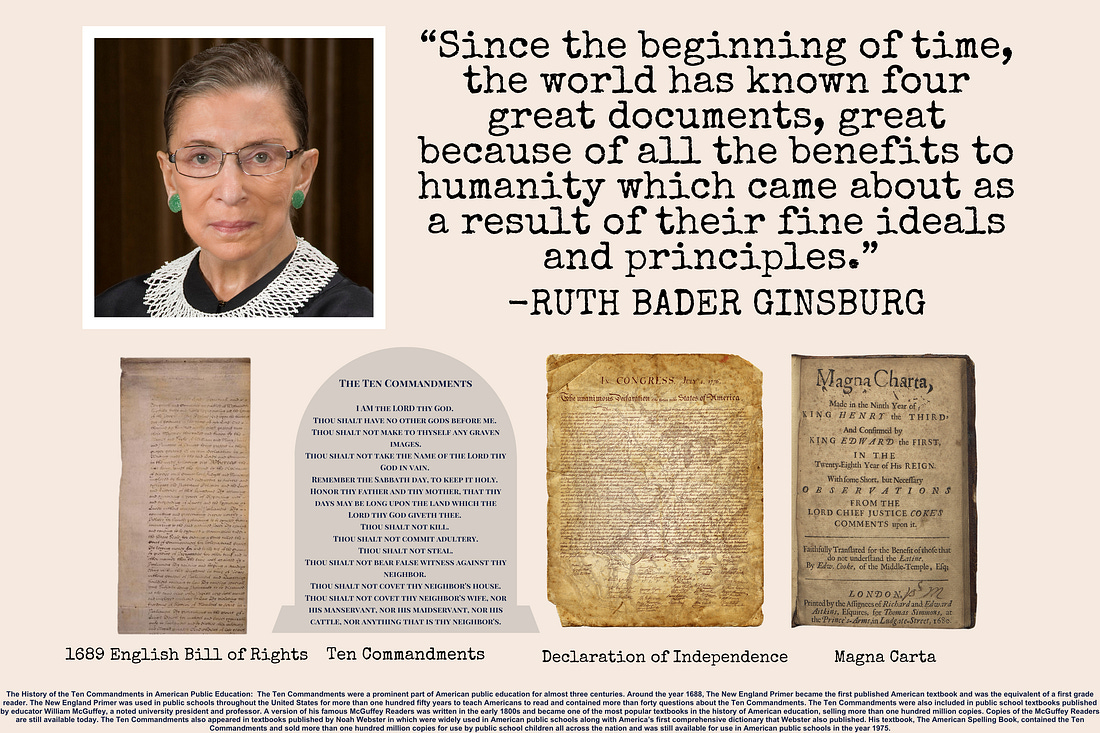 |
Murrill disse que a frase veio de algo que RBG "escreveu em [seu livro] Minhas Próprias Palavras".
Só que RBG não escreveu essas palavras em nenhum momento de sua carreira jurídica . Ela as escreveu na oitava série . Ela simplesmente reimprimiu aquele antigo ensaio no livro.
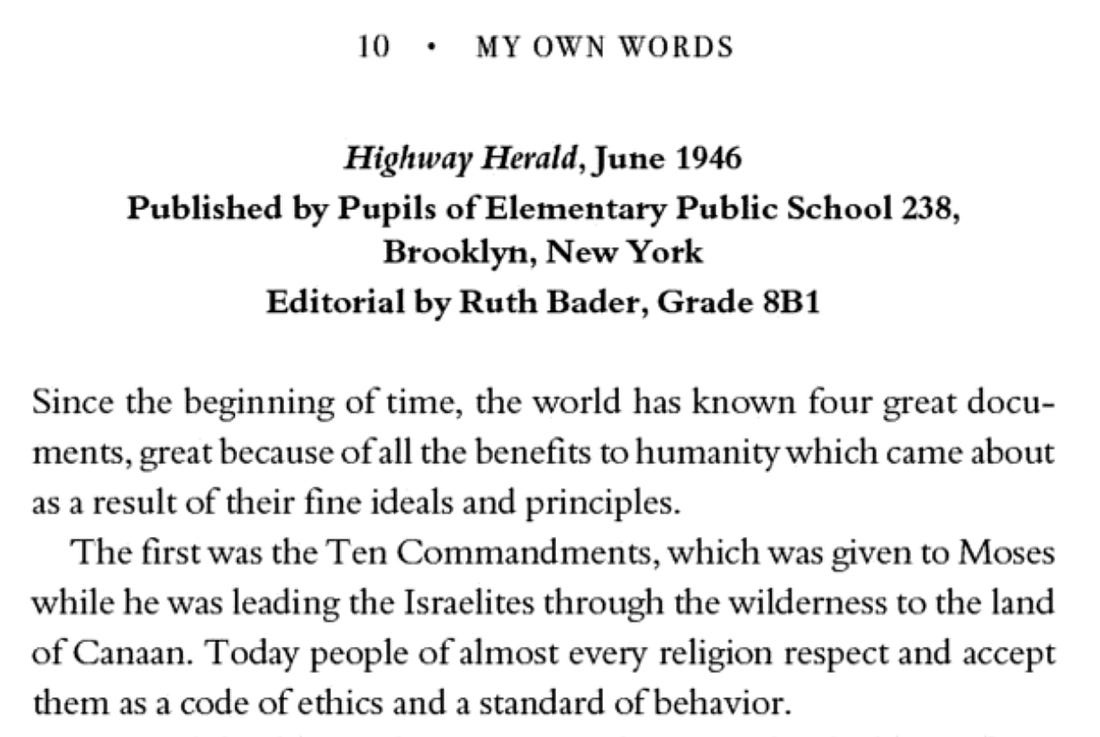 |
Murrill estava literalmente citando a opinião de RBG quando ela era quase uma adolescente , porque citar qualquer coisa que RBG tenha escrito enquanto juíza da Suprema Corte certamente iria contra a lei teocrática da Louisiana.
Outro exemplo de cartaz comparava os Dez Mandamentos aos Dez Mandamentos do Duelo do filme Hamilton :
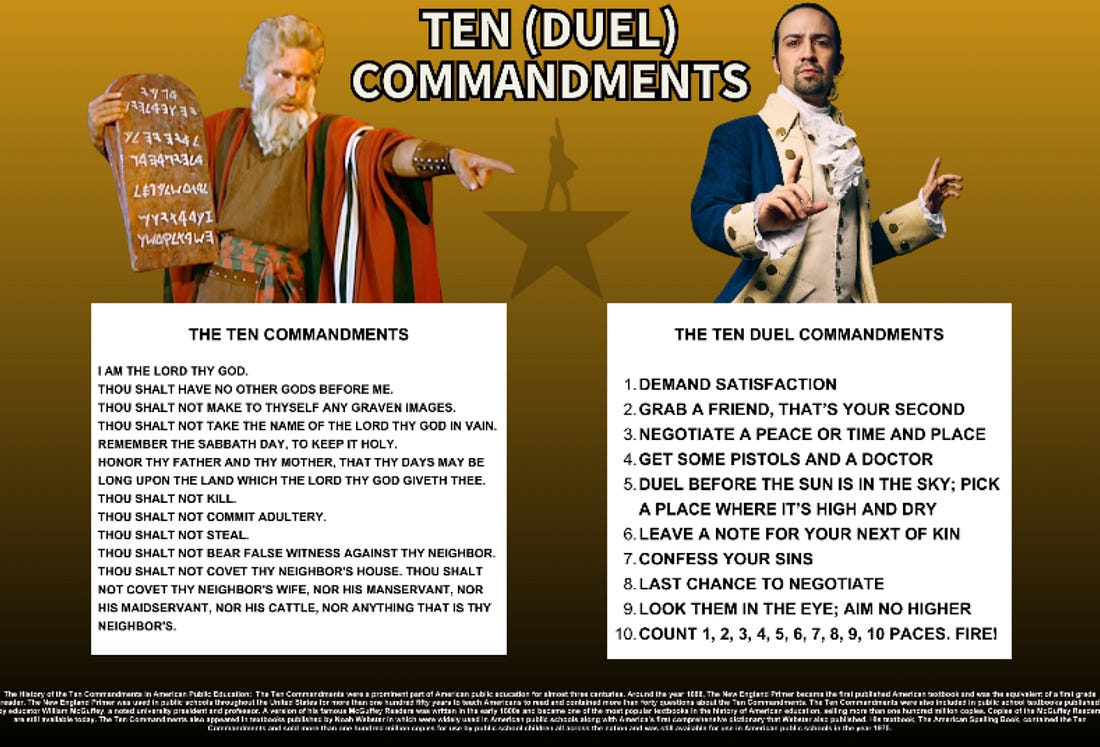 |
Como isso melhorou alguma coisa, era um mistério. As autoridades da Louisiana estavam tentando distrair as pessoas de seu verdadeiro objetivo: impor o cristianismo a todos.
Em outras palavras, não havia como implementar a lei dos Dez Mandamentos sem criar ainda mais problemas legais.
Mas agora, aparentemente, temos que esperar que esses cartazes sejam afixados antes que outro processo possa ser aberto, porque só então os juízes poderão determinar se esses cartazes realmente visam promover uma religião específica.
Os grupos jurídicos que representaram os demandantes expressaram sua decepção com a decisão:
Representados pela Freedom From Religion Foundation, pela ACLU, pela ACLU da Louisiana e pela Americans United for Separation of Church and State, com o escritório de advocacia Simpson Thacher & Bartlett LLP atuando como advogado pro bono, os autores da ação Roake v. Brumley são um grupo multirreligioso de nove famílias da Louisiana com filhos em escolas públicas. As organizações que representam os autores emitiram a seguinte declaração em resposta à decisão:“ A decisão de hoje é extremamente decepcionante e, se mantida, forçará desnecessariamente as famílias de alunos de escolas públicas da Louisiana a um jogo de gato e rato constitucional em cada distrito escolar, onde terão que contestar as exibições de cada distrito individualmente. Precedentes judiciais de longa data deixam claro que nossos clientes não precisam se submeter aos mesmos danos que buscam evitar antes de tomar medidas legais para proteger seus direitos. Mas esta luta não acabou . Continuaremos lutando pela liberdade religiosa das famílias da Louisiana.”…
Os advogados dos demandantes estão explorando todas as vias legais disponíveis para continuar a luta contra essa lei inconstitucional.
Eles não estão decepcionados por terem perdido. Estão decepcionados porque o tribunal conservador está fazendo com que seus clientes superem obstáculos desnecessários para dizerem exatamente as mesmas coisas de antes. Eles podem até ganhar este caso, mas agora terão que esperar mais alguns meses para obter a resposta que poderiam ter obtido agora mesmo.
Eles também ressaltam, no entanto, que essa decisão não tem relação com um processo separado contra a lei dos Dez Mandamentos do Texas. O mesmo Tribunal de Apelações do Quinto Circuito analisou esse caso há cerca de um mês.
Aliás, um dos juízes, o ultraconservador James C. Ho , indicado por Trump, escreveu que simplesmente deixaria a lei em vigor porque acredita que promover o cristianismo nas escolas é perfeitamente legal. Ele também pediu à Suprema Corte que revogasse a decisão do caso Stone v. Graham , de 1980, que considerou inconstitucional a exibição dos Dez Mandamentos nas paredes das salas de aula por falta de uma finalidade legislativa não religiosa.
Uma vez que Stone seja removido do caso, este processo deverá ser facilmente arquivado. Os autores da ação não apresentam nenhuma evidência histórica que sequer sugira que nossos Fundadores considerariam uma exibição passiva dos Dez Mandamentos como um "estabelecimento de religião" inadmissível.
Ho prosseguiu dizendo que os Dez Mandamentos eram apenas parte da história americana porque eram usados no New England Primer , nos livros de leitura de McGuffey e no livro de ortografia americano de Noah Webster. Mas os três livros foram literalmente mencionados na decisão anterior do juiz distrital dos EUA, John deGravelles . Ele explicou que o New England Primer era usado quase exclusivamente em escolas religiosas muito antes do surgimento da educação pública. E embora alguns livros de leitura de McGuffey incluíssem uma história sobre os Dez Mandamentos, outros não. E há todos os tipos de razões pelas quais esses textos caíram em desuso ao longo do último século.
Quando os advogados defensores da separação entre Igreja e Estado argumentaram contra a lei na Louisiana, disseram que "não há evidências de uma aceitação e prática histórica de longa data, muito menos ininterrupta, de exibições permanentes e generalizadas dos Dez Mandamentos em escolas públicas".
E, no entanto, Ho acreditou na mentira sem pensar duas vezes.
O governador da Louisiana , Jeff Landry, não se importou nem um pouco. Ele comemorou a nova decisão, dizendo: "O bom senso está voltando!"
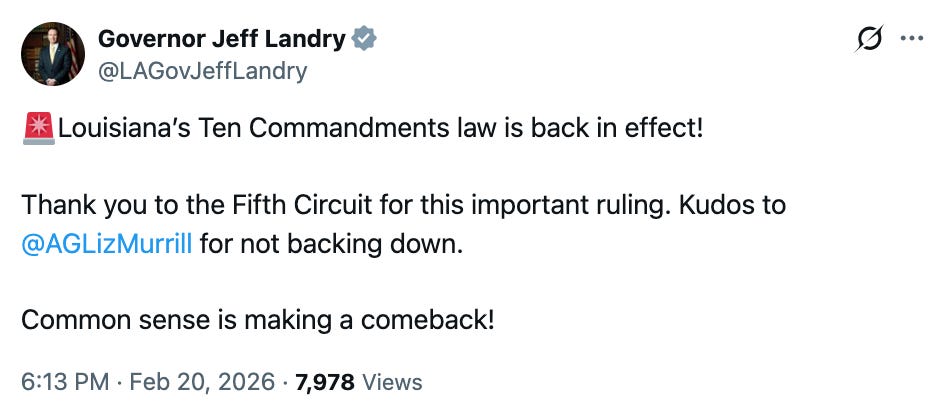 |
O bom senso diria para permitir que os professores fizessem seu trabalho em vez de se tornarem pregadores patrocinados pelo Estado.
Murrill entrou na discussão com sua própria declaração absurda , dizendo: "Não matar nem roubar não deveria ser controverso":
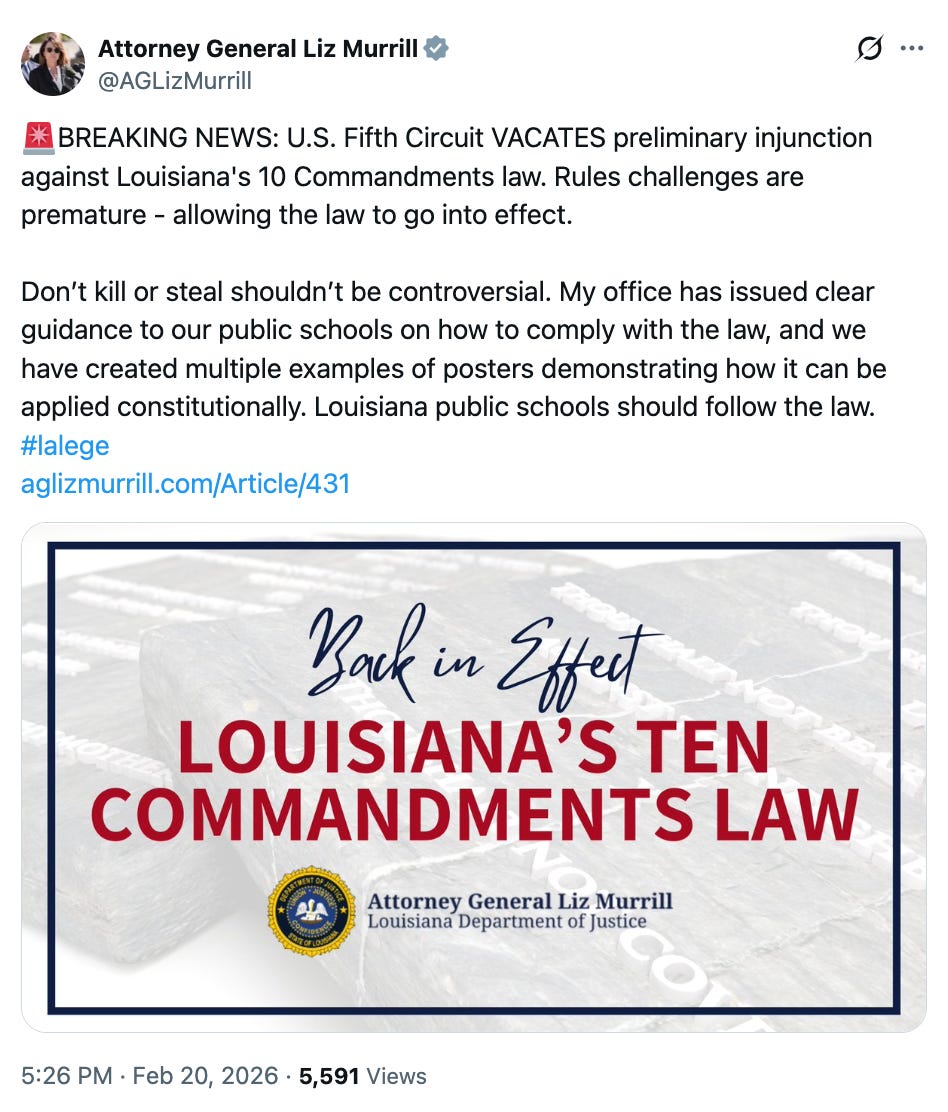 |
Se os dois mandamentos sobre matar e roubar fossem os únicos que ela queria nas salas de aula, estaríamos tendo uma conversa diferente. Mas ela está mentindo e enganando as pessoas propositalmente sobre qual é a verdadeira controvérsia. Murrill também afirma ter divulgado cartazes legais, mas esses são os problemáticos que eu já descrevi anteriormente.
As declarações deles são ridículas porque já sabemos como isso vai terminar:
Um distrito escolar colocará cartazes com os Dez Mandamentos nas salas de aula.
As famílias vão processar.
O juiz de primeira instância inevitavelmente ficará do lado deles, dizendo que os cartazes são ilegais.
Autoridades da Louisiana irão recorrer.
O Quinto Circuito terá que se pronunciar mais uma vez... e voltaremos à estaca zero. Só que desta vez terão que decidir sobre o mérito da questão.
Em outras palavras, o Quinto Circuito está simplesmente adiando o inevitável. Provavelmente é esse o objetivo. Estão ganhando tempo para que os cartazes cristãos sejam afixados, talvez na esperança de que o outro lado simplesmente desista.
O que torna essa decisão tão irritante é que o Quinto Circuito não está lidando com uma questão constitucional complexa; está evitando-a. Os juízes sabem exatamente o que a Louisiana pretende fazer porque a Louisiana lhes disse. Não há nada de especulativo em impor um documento religioso nas paredes das salas de aula. Ao declarar o caso como não "maduro", o Quinto Circuito protegeu uma lei claramente inconstitucional por tempo suficiente para que ela cause danos reais. Famílias que já sabem que seus direitos estão sendo violados agora precisam esperar até que seus filhos sejam expostos a mensagens religiosas patrocinadas pelo Estado antes de poderem buscar reparação. Não é assim que as proteções constitucionais deveriam funcionar. A Primeira Emenda existe para prevenir violações, não para exigir que as vítimas as suportem primeiro para que os tribunais possam reconhecer o óbvio.
O Quinto Circuito teve todas as oportunidades para impedir esse abuso de poder republicano antes mesmo de começar. Em vez disso, optou por se omitir porque alguns juízes não queriam fazer cumprir a Constituição. Tudo isso não passa de uma manobra para ganhar tempo.

Ten Commandments posters must go up in schools before Louisiana families can sue, says federal court
The Fifth Circuit admitted the law may be unconstitutional, but they're forcing students to endure religious displays before challenging them
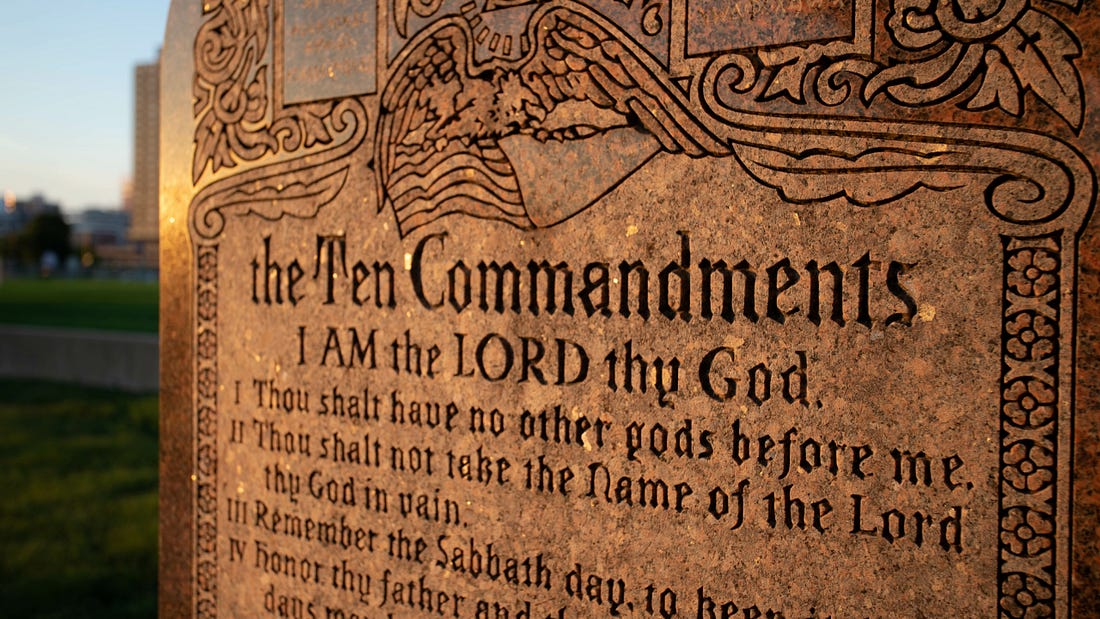
In a decision that seems pointless as much as it is frustrating, an appellate court ruled that the Ten Commandments can be posted in Louisiana public schools and that legal challenges against it cannot be filed until after that happens.
 |
A previous lawsuit to block Louisiana’s Ten Commandments law had been successful at the district court level and the appellate court level—the judges even said the law was “plainly unconstitutional”—but the full Fifth Circuit Court of Appeals asked to reconsider the case and they’ve now decided 12-6 to overturn their colleagues’ earlier decision. (You can read the longer history of this case here.)
When a subset of those judges ruled in the Plaintiffs’ favor last year, the judges said they didn’t need to wait for the Ten Commandments to be posted because the law already made clear what those posters would have to say. Why force children to be subject to religious proselytization when you can prevent it in advance? In fact, the District Court judge said letting the law go into effect (so the Plaintiffs would encounter the displays) would be a “considerable hardship” upon those families. There was no need to wait, he wrote, when the law was this blatantly illegal.
That’s apparently not how the full Fifth Circuit saw it.
They wrote in their 46-page decision that the families involved needed to wait to see the posters before they could sue “because we do not yet know—and cannot yet know—how the text will be used.” (In legal terms, they said the case was not “ripe” yet.)
Asking us to declare—here and now, and in the abstract—that every possible H.B. 71 display would violate the Establishment Clause would require precisely what Texas forbids: the substitution of speculation for adjudication. It would oblige us to hypothesize an open-ended range of possible classroom displays and then assess each under a context-sensitive standard that depends on facts not yet developed and, indeed, not yet knowable. That exercise exceeds the judicial function. It is not judging; it is guessing. And because it rests on conjecture rather than a concrete factual record, it does not cure the ripeness defect—it compounds it.
…
We do not know, for example, how prominently the displays will appear, what other materials might accompany them, or how—if at all— teachers will reference them during instruction. More fundamentally, we do not even know the full content of the displays themselves. Although the statute requires inclusion of the Commandments and a context statement, it expressly permits additional content—such as “the Mayflower Compact, the Declaration of Independence, and the Northwest Ordinance”—to appear alongside them.
There’s a lot of B.S. packed into those paragraphs.
We know that because their own members said as much earlier. In the Fifth Circuit panel decision from June, the judges said they knew what the posters would look like because the specs were listed in the bill. They knew the size and the wording, adding “The text of H.B. 71 provides sufficient information for a fact-intensive and context-specific analysis.”
It’s also worth mentioning those those secular texts, like the Mayflower Compact and the Declaration of Independence, are not required to go up alongside the Christian posters. They’re optional. The Christian message, on the other hand, is mandatory. That was the problem.
One of those previous judges predictably dissented with the new ruling, explaining that nothing in his earlier reasoning had changed:
Bound by Stone v. Graham and its progeny, and mindful that we are not the Supreme Court, I conclude that permanently posting the Ten Commandments in every public school classroom, without curricular incorporation and with compulsory attendance, violates the Establishment Clause. Our court avoids confronting that conclusion only through procedural artifice. I dissent.
The reason several judges said they didn’t need to wait was because Louisiana officials had already offered up examples of what the Ten Commandments posters could theoretically look like and they were all legal disasters. Attorney General Liz Murrill even held a press conference in which she displayed multiple examples of those posters that she said would be welcome in public schools and couldn’t possibly offend anyone.
How pathetic was that defense?
Consider this sample poster that included a picture of the late Supreme Court justice Ruth Bader Ginsburg and a quotation in which she referred to the Commandments as one of the world’s “four great documents.”
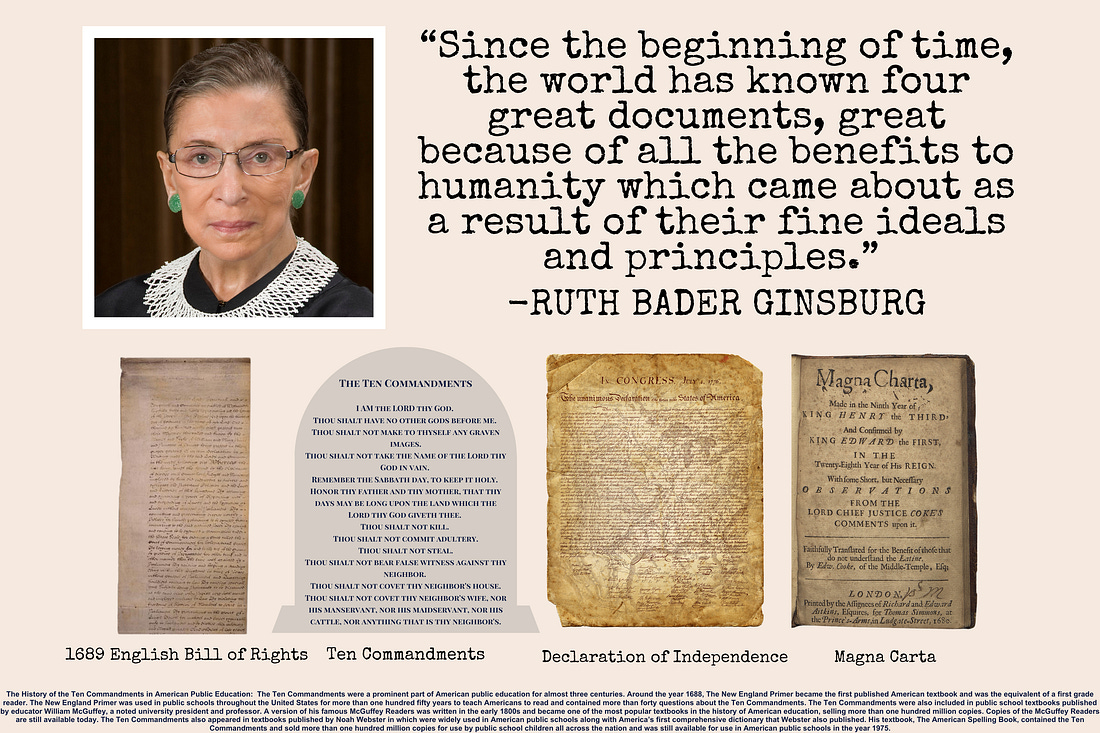 |
Murrill said that the line came from something RBG “wrote in [her book] My Own Words.”
Except RBG didn’t write those words at any point in her legal career. She wrote them in 8th grade. She simply reprinted that old essay in the book:
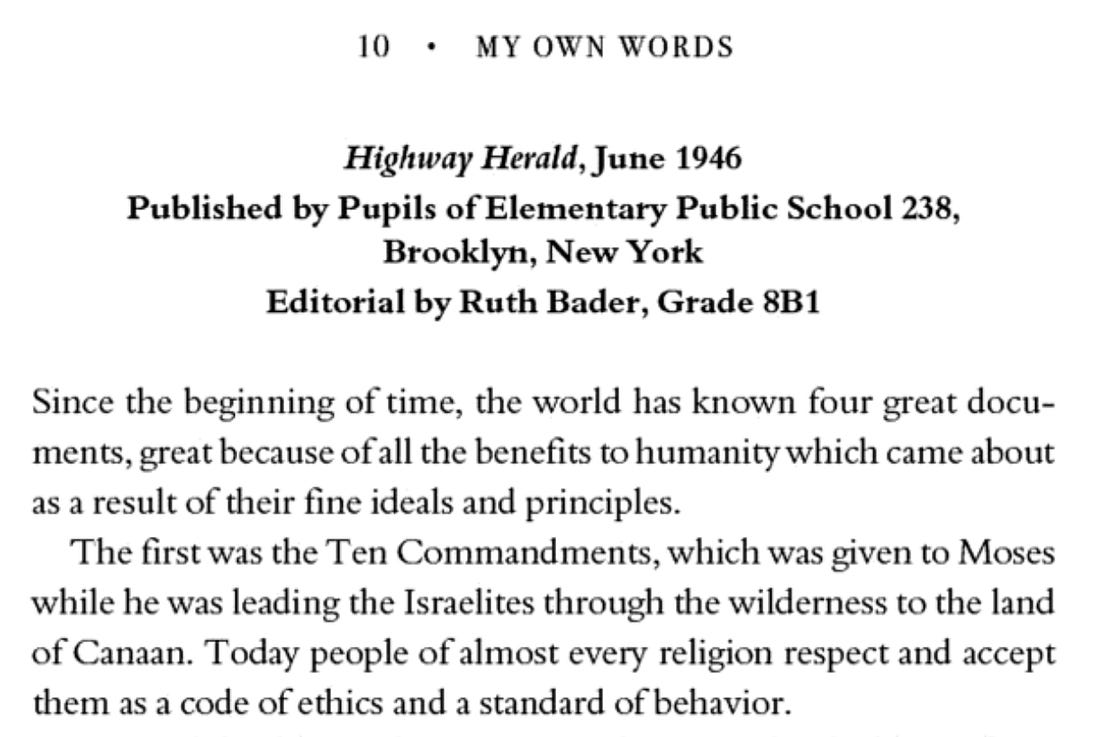 |
Murrill was literally quoting RBG’s opinion when she was barely a teenager because quoting anything RBG ever wrote as a sitting Supreme Court justice would undoubtedly go against Louisiana’s theocratic law.
Another sample poster compared the Ten Commandments to the Ten Duel Commandments from Hamilton:
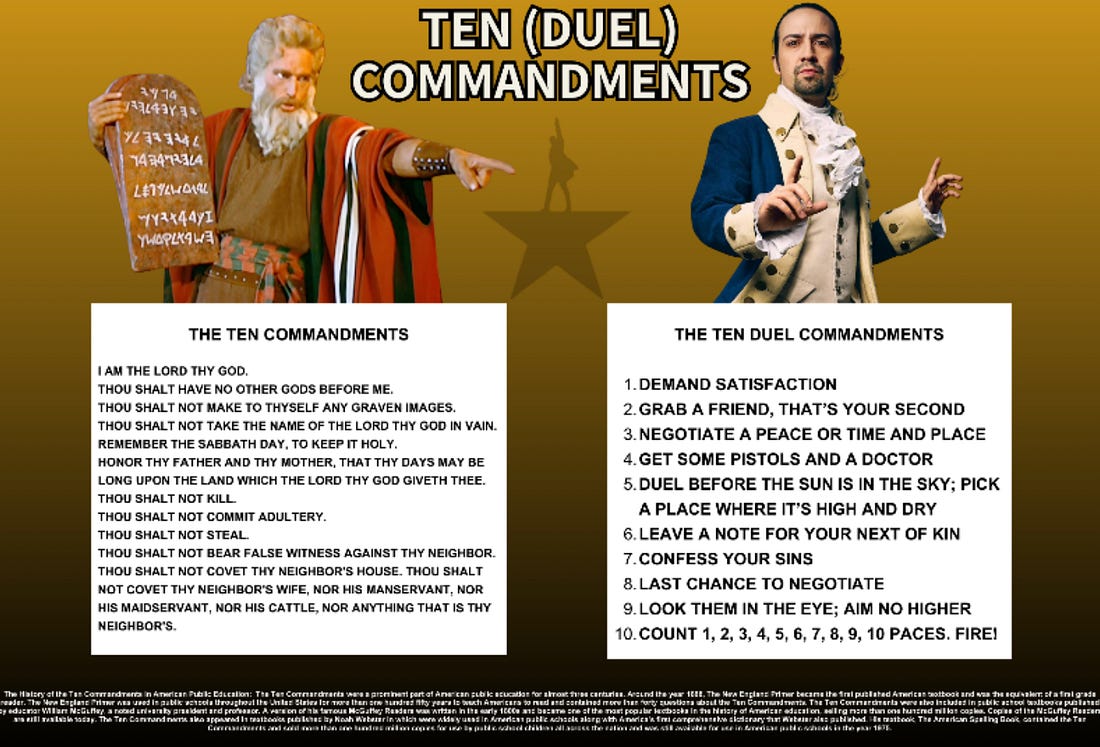 |
How that made anything better was anyone’s guess. Louisiana officials were trying to distract people from their actual goal of shoving Christianity in everyone’s faces.
To put it another way, there was no way to implement the Ten Commandments law without creating even more legal problems.
But now, apparently, we have to wait for those posters to go up before another lawsuit can be filed because only then will the judges be able to figure out if these posters are truly about promoting one specific religion.
The legal groups that represented the Plaintiffs expressed their disappointment with the decision:
Represented by the Freedom From Religion Foundation, the ACLU, ACLU of Louisiana, and Americans United for Separation of Church and State, with Simpson Thacher & Bartlett LLP serving as pro bono counsel, the plaintiffs in Roake v. Brumley are a multifaith group of nine Louisiana families with children in public schools. The organizations representing the plaintiffs issued the following statement in response to the decision:“Today’s ruling is extremely disappointing and would, if left in place, will unnecessarily force Louisiana’s public school families into a game of constitutional whack-a-mole in every school district where they must challenge each individual school district’s displays. Longstanding judicial precedent makes clear that our clients need not submit to the very harms they are seeking to prevent before taking legal action to protect their rights. But this fight isn’t over. We will continue fighting for the religious freedom of Louisiana’s families.”…
The plaintiffs’ counsel is exploring all legal pathways forward to continue the fight against this unconstitutional law.
They’re not disappointed because they lost. They’re disappointed because the conservative court is making their clients jump over pointless hurdles in order to say all of the same things as before. They may very well win this case—but they’ll now have to wait several more months to get the response they could have gotten right now.
They also point out, however, that this ruling has nothing to do with a separate challenge against Texas’ Ten Commandments law. The same full Fifth Circuit Court of Appeals heard that case about a month ago.
Incidentally, one of the judges, archconservative and Trump appointee James C. Ho, wrote that he would simply allow the law to remain in place because he thinks promoting Christianity in schools is perfectly legal. He also called on the Supreme Court to overturn Stone v. Graham, a 1980 decision that said putting the Ten Commandments on classroom walls was unconstitutional because it lacked a nonreligious, legislative purpose.
Once Stone is removed, this case should be easy to dismiss. Plaintiffs present no historical evidence that remotely suggests that our Founders would have regarded a passive display of the Ten Commandments as an impermissible “establishment of religion.”
Ho went on to say that the Ten Commandments was just part of American history because it was used in the New England Primer, McGuffey’s Readers and Noah Webster’s American Spelling Book. But all three books were literally mentioned in the earlier decision by U.S. District Judge John deGravelles. He explained that the New England Primer was used almost exclusively in religious schools long before the rise of public education. And while some McGuffey’s Readers included a story about the Ten Commandments, others didn’t. And there are all kinds of reasons all of these texts went out of style over the past century.
When lawyers on the side of church/state separation argued against the law in Louisiana, they said “there is no evidence of a longstanding, let alone unbroken, historical acceptance and practice of widespread, permanent displays of the Ten Commandments in public schools.”
And yet Ho fell for the lie without giving it a second thought.
Louisiana Gov. Jeff Landry didn’t mind at all. He celebrated the new ruling, saying “Common sense is making a comeback!”
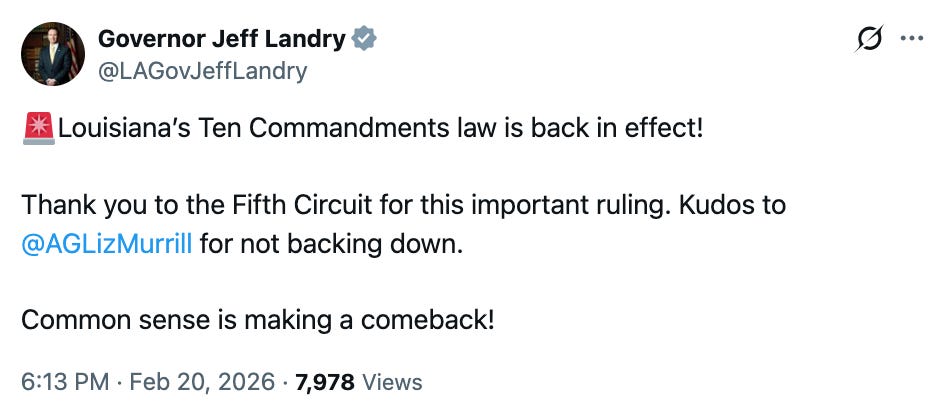 |
Common sense would be allowing teachers to do their jobs instead of becoming state-sponsored preachers.
Murrill joined in with her own absurd statement saying “Don’t kill or steal shouldn’t be controversial”:
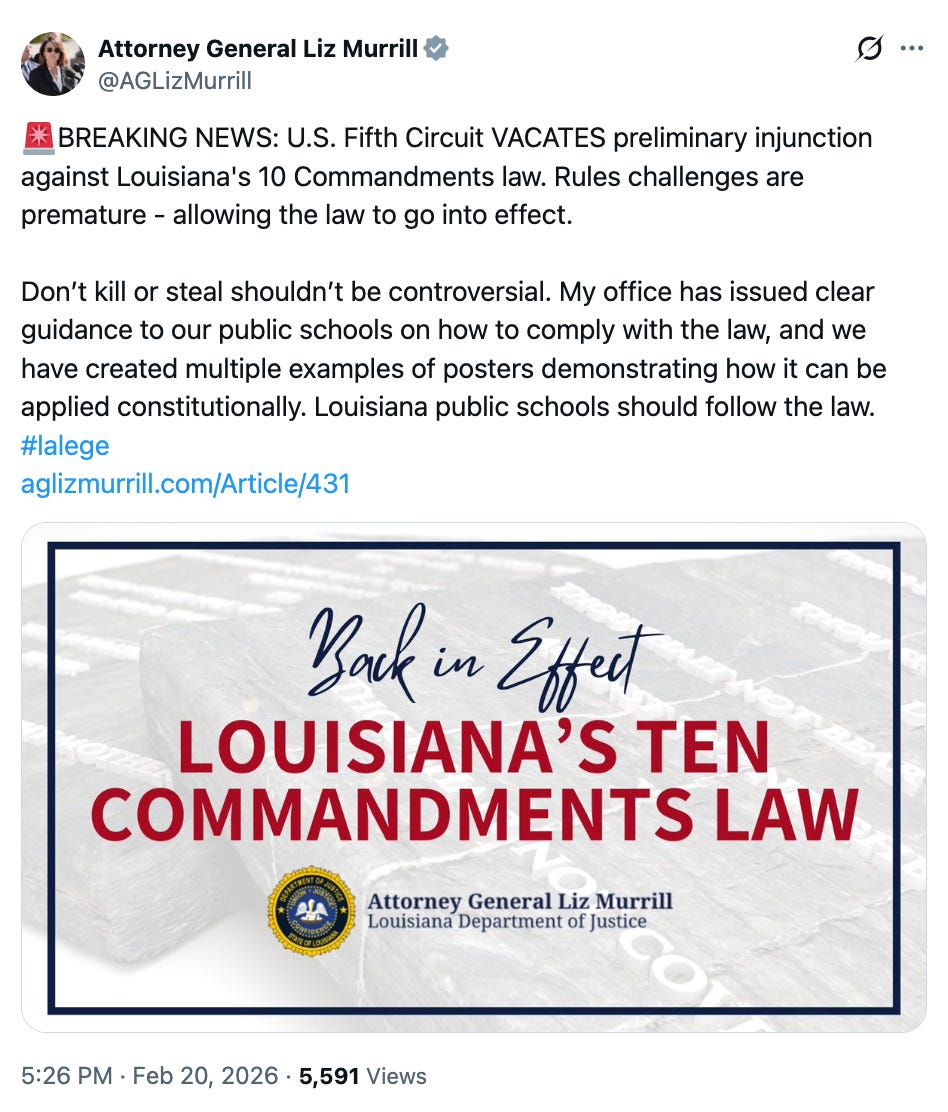 |
If the two commandments about killing and stealing are the only ones she wanted up in classrooms, we’d be having a different conversation. But she’s lying and purposely misleading people about what the real controversy is. Murrill also claims she released legal posters but those are the problematic ones I already described earlier.
Their statements are ridiculous because we already know how this will play out:
A school district will put up the Ten Commandments posters in classrooms.
Families will sue.
The lower court judge will inevitably side with them, saying the posters are illegal.
Louisiana officials will appeal.
The Fifth Circuit will have to weigh in once again… and we’ll be right back to where we started. Only this time they’ll have to rule on the merits.
Which is a long way of saying the Fifth Circuit is simply delaying the inevitable. That’s probably the point. They’re buying time for the Christian posters to go up, perhaps hoping the other side will just give up.
What makes this ruling so annoying is that the Fifth Circuit isn’t grappling with a difficult constitutional question; it’s avoiding one. The judges know exactly what Louisiana intends to do because Louisiana told them. There’s nothing speculative about forcing a religious document onto classroom walls. By declaring the case not “ripe,” the Fifth Circuit has insulated a plainly unconstitutional law long enough for it to cause real harm. Families who already know their rights are being violated must now wait until their children are subjected to state-sponsored religious messaging before they can seek relief. That’s not how constitutional protections are supposed to work. The First Amendment exists to prevent violations, not to require victims to endure them first so courts can acknowledge the obvious.
The Fifth Circuit had every opportunity to stop this abuse of Republican power before it began. Instead, it chose to step aside because some judges didn’t want to enforce the Constitution. This is all nothing more than a stalling technique.

